
What is a Hydraulic Pump Drive?
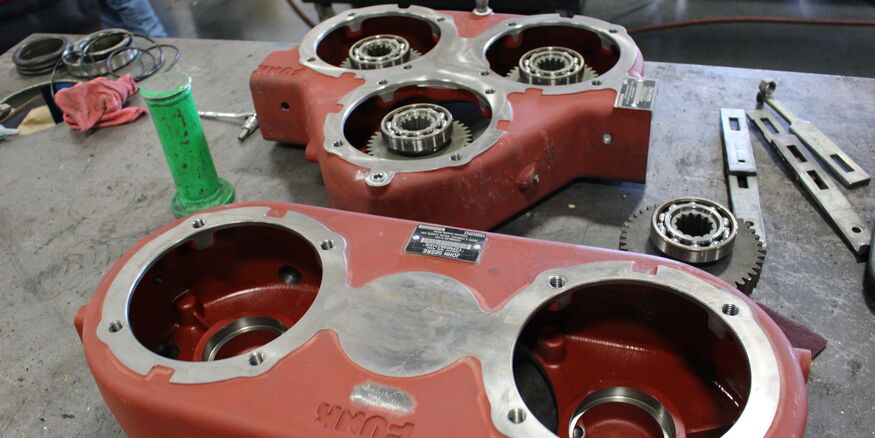
At a Glance
- A pump drive connects an engine or motor to one or more hydraulic pumps.
- Gear-driven models can raise or lower pump speed with a set ratio.
- Pump drives go by many names, including splitter drive and pump mount.
Almost every modern off-highway machine depends on hydraulics, and every hydraulic system needs a way to turn the pumps. A hydraulic pump drive is the component that makes that connection. This article explains what a pump drive is, why machines use one, the names it goes by, and the basic options to understand before selecting one.
What Is a Hydraulic Pump Drive?
A hydraulic pump drive connects a prime mover to one or more hydraulic pumps. The most common prime movers are industrial diesel engines and electric motors. The pump drive mounts to the engine or motor, takes in its rotating power, and delivers that power to the pumps mounted on it. The pumps then create the hydraulic flow and pressure that operate the machine's cylinders, motors, and other auxiliary functions.
Why Machines Use Pump Drives
Most machines need more than one hydraulic circuit. A single drill rig, paver, or harvester may have separate pumps for propulsion, work functions, steering, and cooling fans. A pump drive gives one engine several pump mounting locations, typically from one up to eight, so a single power source can run every circuit at once.
Pump drives also solve a speed problem. Engines and hydraulic pumps each have an RPM range where they perform best, and those ranges are not always the same. A gear-driven pump drive uses a fixed ratio so the engine can run at its optimal speed while the pumps run at theirs.
Other Names for a Pump Drive
Pump drives are called many different things depending on the manufacturer, the industry, and the person you ask. Common terms include:
- Pump drive or hydraulic pump drive
- Splitter drive or splitter gearbox
- Gearbox
- Pump mount or mount
- PTO (power take-off)
These terms overlap, which can cause confusion. In industrial equipment, PTO usually refers to a clutch-type power take-off that drives auxiliary equipment through a shaft or belts, so it is worth confirming which product someone means when the term comes up.
Pump Mounts vs. Gear-Driven Pump Drives
Pump Mounts
The simplest style is a pump mount, sometimes called a pump drive plate. It has no gear train. Its only job is to connect one hydraulic pump to the prime mover and turn it at engine speed. Because there are no gears, there are no ratio options. Pump mounts are compact, simple, and cost effective when one pump at engine speed is all a machine needs.
Gear-Driven Pump Drives
Gear-driven pump drives contain a gear train that distributes power to one or more pump pads. Multi-pad models are offered with one to eight pads. The gearing can run the pumps at a 1:1 ratio or at an increased or decreased speed. Depending on the brand and model, buyers can often choose from ten or more ratio options.
Input and Output: Two Terms to Know
Two terms come up in every pump drive conversation. The input is the connection between the pump drive and the prime mover. The outputs are the pump pads where hydraulic pumps mount. Nearly every selection decision falls into one of those two categories, so they are useful terms to have before talking with a supplier or application engineer.
Common Pump Drive Manufacturers
Several manufacturers build pump drives for industrial and off-highway equipment, each with its own strengths:
- Durst: Modular pump drives with one to eight pump pads and power ratings up to 1,025 HP. Durst also owns the legacy Hub City and Terrell pump drive lines, which are still found on many older machines.
- Funk: A pump drive manufacturer with roots going back to 1934, now owned by John Deere. Funk offers modular pump drives with one to five pads and power ratings up to 950 HP.
- Twin Disc: A pump drive line that grew from the company's acquisition of Italian manufacturer Technodrive, known for accommodating unusual input and output requirements.
- NAMCO and Cotta: Custom gearbox manufacturers that build pump drives beyond the ratings of standard catalog products. NAMCO covers roughly 350 to 2,500 HP, and Cotta builds units up to 3,000 HP.
What to Know Before Choosing a Pump Drive
Having a few details ready makes selection faster and more accurate:
- Prime mover: Engine or motor make and model, plus SAE flywheel and housing size
- Pumps: Number of pumps and the SAE flange and shaft size of each
- Speed: Engine operating RPM and the RPM each pump needs
- Power: Total horsepower or torque, and the load on each pad
- Disconnect: Whether the pumps need to be shut off while the engine runs
Summary
A hydraulic pump drive connects a diesel engine or electric motor to the hydraulic pumps that run a machine's auxiliary functions. Simple pump mounts turn a single pump at engine speed, while gear-driven pump drives power one to eight pumps and can raise or lower pump speed through a fixed ratio. Knowing the input, the outputs, and the speed and power each pump needs is the starting point for selecting the right unit.
Frequently Asked Questions
It transfers power from a diesel engine or electric motor to one or more hydraulic pumps so they can supply hydraulic power to the machine.
Not exactly. The terms are often used interchangeably, but in industrial equipment a PTO usually means a clutch-type unit that drives equipment through a shaft or belts, while a pump drive is built to mount hydraulic pumps.
Standard pump drives are available with one to eight pump pads. Custom units can be built for other configurations.
Gear-driven pump drives can, using a 1:1, speed-increasing, or speed-reducing ratio. Pump mounts without a gear train turn the pump at engine speed.
Hydraulic Pump Drives
Lorem ipsum dolor sit amet, consectetur adipiscing elit, sed do eiusmod tempor incididunt ut labore et dolore aliqua.
- What is a Hydraulic Pump Drive?
- How Does a Hydraulic Pump Drive Work?
- Types of Hydraulic Pump Drives
- Hydraulic Pump Drive Applications and Industries