
Types of Hydraulic Pump Drives
At a Glance
- Pump drives are grouped by pad count, input style, and output option.
- Inputs include drive plates, shafts, clutches, and C-face adapters.
- Outputs range from SAE pump pads to output shafts and live PTOs.
Hydraulic pump drives come in many configurations, and the right one depends on how a machine is powered, how many pumps it runs, and how those pumps need to be controlled. The easiest way to sort through the options is to look at three things: how many pumps the drive carries, how it connects to the prime mover, and how the pumps connect to it.
Types by Pad Count
Pump Mounts
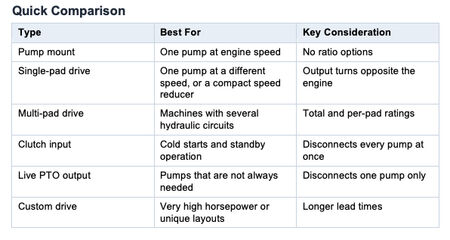
A pump mount connects one hydraulic pump to the engine with no gear train. The pump runs at engine speed and there are no ratio options. Pump mounts are the simplest and most compact choice for single-pump machines.
Single-Pad Pump Drives
Single-pad pump drives add a gear train for one pump, which allows a speed-increasing or speed-reducing ratio. With an output shaft in place of a pump, single-pad units can also work as compact speed reducers, typically in ratios from 1:1 to about 3.12:1. Because the gearing reverses direction, they suit applications that need anti-engine rotation.
Multi-Pad Pump Drives
Multi-pad pump drives, often called splitter drives, carry two to eight pumps around a central gear train. They are the standard choice for machines with several hydraulic circuits, such as drill rigs, pavers, and harvesters.
Types by Input Connection
Drive Plate Input
The most common input is a drive plate or coupling that bolts to the engine flywheel, with the pump drive housing bolting to the flywheel housing. These inputs follow SAE flywheel and housing standards so they fit most industrial engines.
Shaft Input
A shaft input uses a keyed, flanged, or splined shaft and is often called a remote input. The pump drive mounts away from the engine and connects through a driveshaft, which gives designers more flexibility in machine layout. Tractor PTO input shafts fall into this group and let an agricultural tractor serve as the prime mover.
Clutch Input
A clutch input mounts to the engine using the same SAE standards as a drive plate but adds a clutch between the engine and the pump drive. The operator can shut off the pump drive and every pump on it while the engine runs. This is especially helpful in cold climates, where starting an engine without a full load is easier on the engine.
C-Face Flange Input
A C-face flange adapter connects the pump drive directly to an electric motor. As electric and hybrid machines become more common, this input type is seeing wider use.
Types by Output Option
SAE Pump Flange and Shaft Adapters
Most pump drive outputs use SAE-standard flange and shaft adapters to mount hydraulic pumps. The most common sizes are SAE A through F. Your hydraulic pump supplier can confirm the flange and shaft size of each pump, which determines the adapters needed on the pump drive.
Output Shafts
Most manufacturers allow an output shaft in place of a pump at any pad. The shaft can connect to a driveline that powers other equipment, which lets a pump drive work like a gearbox. Output shafts come in the same keyed, flanged, and splined styles as input shafts.
Live PTO Outputs
A live PTO adds an air- or hydraulically-actuated clutch at an individual pad. It disconnects a single pump while the rest of the drive keeps running. Live PTOs are an underused option that can save energy and extend pump life on functions that are not always in use.
Standard vs. Custom Pump Drives
Standard pump drives from manufacturers such as Durst, Funk, and Twin Disc use modular designs, which keeps many configurations available on short lead times. Standard lines cover a wide range: Durst offers one to eight pads up to 1,025 HP, and Funk offers one to five pads up to 950 HP.
When an application exceeds standard ratings or needs an unusual layout, custom manufacturers such as NAMCO and Cotta build engineered pump drives. NAMCO covers roughly 350 to 2,500 HP, and Cotta builds units up to 3,000 HP. Custom designs typically carry longer lead times.
Summary
Hydraulic pump drives can be sorted by pad count, input connection, and output option. Pump mounts and single-pad drives handle one pump, while multi-pad splitter drives run up to eight. Drive plate, shaft, clutch, and C-face inputs adapt the drive to different engines, motors, and machine layouts, and SAE pump pads, output shafts, and live PTOs define how power leaves the drive. Standard modular units cover most applications, with custom designs available for very high horsepower.
Frequently Asked Questions
A multi-pad pump drive with a drive plate input that bolts to an SAE engine flywheel and housing is the most common configuration.
Splitter drive is another name for a multi-pad pump drive, which splits engine power between two or more hydraulic pumps.
Yes. A C-face flange input lets a pump drive mount directly to an electric motor.
Most pump drives accept SAE A through F pump flanges and shafts through interchangeable adapters.
Yes. A single-pad pump drive with an output shaft can serve as a compact speed reducer when the ratio, torque, and rotation fit the application.
Hydraulic Pump Drives
Lorem ipsum dolor sit amet, consectetur adipiscing elit, sed do eiusmod tempor incididunt ut labore et dolore aliqua.
- What is a Hydraulic Pump Drive?
- How Does a Hydraulic Pump Drive Work?
- Types of Hydraulic Pump Drives
- Hydraulic Pump Drive Applications and Industries