
Types of Heavy-Duty Transmissions
At a Glance
- Powershift transmissions are the standard for loaders and material handlers.
- Hydrostatic and hydromechanical drives offer smooth, variable speed.
- The right type depends on duty cycle, speed range, and control needs.
No single transmission design fits every machine. A forklift, a skid steer, a mining loader, and a farm tractor each need something different from their drivetrain. This article compares the main types of heavy-duty transmissions, how each one works, and where each fits best.
Manual Transmissions
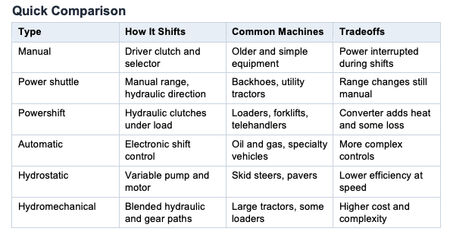
Manual transmissions use a driver-operated clutch and gear selector, much like a manual car or truck. They are simple, efficient, and inexpensive, but power to the wheels is interrupted during every shift. Today they are found mainly on older and simpler equipment.
Powershuttle Transmissions
A powershuttle transmission combines manual speed selection with hydraulic forward and reverse clutches. The operator can change direction without using a clutch pedal, which makes it well suited to machines that shuttle back and forth, such as backhoe loaders and utility tractors.
Powershift Transmissions
Powershift transmissions use hydraulically applied clutch packs to change both speed and direction under load. Usually paired with a torque converter, they are the most common transmission in wheel loaders, forklifts, telehandlers, container handlers, and graders. Manufacturers such as Dana Spicer, ZF, Clark, and Carraro offer powershift transmissions for a wide range of off-highway machines.
Countershaft Powershift
Countershaft designs arrange gears on parallel shafts with a clutch pack on each shaft. They are flexible to package, relatively easy to service, and widely used in construction and material handling equipment.
Planetary Powershift
Planetary designs use sun, planet, and ring gear sets controlled by clutches and brakes. They are compact and handle very high torque, making them common in large loaders, mining machines, and heavy haulers.
Automatic Transmissions
Automatic transmissions are powershift units with electronic controls that select gears without operator input. In off-highway and industrial service, they are often used where long run times and consistent shifting matter, including oil and gas equipment such as well service rigs and fracturing pumps.
Hydrostatic Transmissions
A hydrostatic transmission replaces gears with a hydraulic pump driven by the engine and one or more hydraulic motors at the wheels or tracks. Changing pump displacement gives infinitely variable speed and smooth direction changes. Hydrostatic drives are common in skid steers, compact track loaders, pavers, and other machines that need precise low-speed control. They are less efficient than gear drives at higher travel speeds.
Hydromechanical Transmissions
Hydromechanical transmissions, often called continuously variable transmissions (CVTs), split power between a hydrostatic path and a mechanical gear path and combine them through planetary gearing. This gives the smooth, variable speed of a hydrostatic drive with much better efficiency. They are increasingly used in large agricultural tractors and some wheel loaders.
Marine Transmissions in Industrial Service
Marine transmissions provide reduction and reversing in a compact package with integrated clutch engagement. Beyond boats, they are also used in stationary industrial equipment, such as irrigation pumps, where a disconnect and speed reduction are needed.
Electric and Hybrid Drivetrains
Electric motors deliver full torque from zero speed, which reduces the need for multiple gear ranges. Electric and hybrid machines often use simplified single- or two-speed gearboxes, and this segment continues to grow in material handling and compact
Choosing the Right Transmission Type
- Duty cycle: How often the machine changes direction and how long it runs under load
- Speed range: Whether the machine mostly works at low speed or also travels
- Control needs: How precisely ground speed must be controlled
- Efficiency and heat: How much power loss and cooling capacity the machine can accept
- Serviceability: Parts availability and the skills needed to maintain it equipment.
Summary
Heavy-duty transmissions range from simple manual gearboxes to powershift, automatic, hydrostatic, and hydromechanical designs. Powershift transmissions paired with torque converters remain the standard for loaders and material handlers, while hydrostatic drives suit compact machines that need precise low-speed control and hydromechanical drives combine variable speed with high efficiency. Duty cycle, speed range, and control needs determine which type fits a machine best.
Frequently Asked Questions
Torque converter powershift transmissions are the most common in wheel loaders, forklifts, telehandlers, and other material handling equipment.
A powershift uses gears and hydraulic clutches to select fixed ranges, while a hydrostatic uses a hydraulic pump and motor for infinitely variable speed.
A powershuttle has hydraulic forward and reverse clutches for clutchless direction changes, with gear ranges still selected manually.
It is a continuously variable transmission that blends hydrostatic and mechanical power paths for smooth speed control with high efficiency.
Heavy-Duty Transmissions
Lorem ipsum dolor sit amet, consectetur adipiscing elit, sed do eiusmod tempor incididunt ut labore et dolore aliqua.
- Heavy-Duty Off-Highway Transmission Guide
- Industrial Transmission Components: What's Inside a Powershift Transmission
- Types of Heavy-Duty Transmissions